“The Mysterious Deep Waters of the Mississippi Black Sea”
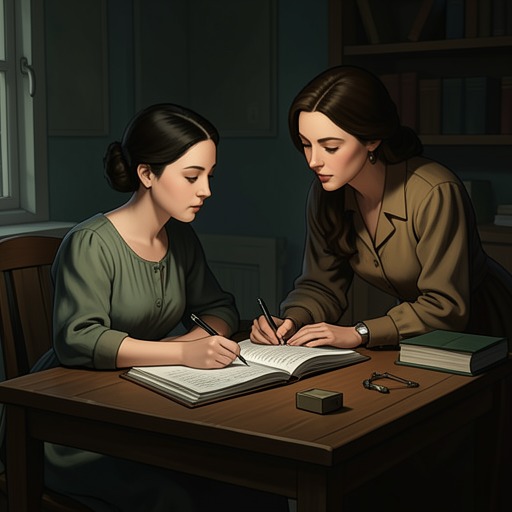
Women TalkingThe Mysterious Deep Waters of the Mississippi Black Sea names an analogy that August Epp offers to the women of Molotschna Colony: beneath the Black Sea’s calm surface, a hidden river may sustain life in depths where ordinary conditions seem inhospitable. The image is meant to encourage hope, but it does not settle into a single meaning. Mariche Loewen hears in it a warning that the women should remain beneath male power; Salome Friesen and Ona Friesen reshape it as an image of the women themselves. Its force lies in that contest over interpretation, as much as in the possibility of life persisting under pressure.
The scientific image and its limits
August Epp introduces the analogy after the women have ended the first part of their meeting with a hymn. He asks permission to begin the next part with a fact that might also serve as metaphor and inspiration. He recalls that Mennonites of Molotschna Colony came to settle their land by way of the Black Sea, where their members had lived near Odessa for centuries before they began to be slaughtered. The historical route gives his image a connection to collective memory, not simply to an abstract body of water.
The fact he presents concerns the Black Sea’s distinct layers. Its deep waters do not mix with the oxygen-bearing upper waters, leaving the depths without life. Those anoxic conditions preserve fossils so remarkably that images of soft body parts remain visible. Yet the surface appears calm, and a mysterious underwater river is thought by scientists to sustain life in the inhospitable depths. August Epp also makes the uncertainty explicit: the scientists have no way to prove that the river can do so. The image therefore joins a striking possibility to a limit on what can be known. It offers hope, but not evidence that hope is guaranteed.
That distinction matters in the meeting. The women’s response is mixed, and silence is common. Ona Friesen, who appreciates facts, thanks August Epp; Mariche Loewen, who has been looking out of the window, turns back to challenge the implication she hears. The same image that August Epp presents as a way to imagine survival can be read as a model of the colony’s unequal order.
Mariche Loewen’s challenge and August Epp’s correction
Mariche Loewen asks whether the upper waters are meant to represent the men of Molotschna Colony and the lower waters the women, forced to thrive mysteriously under pressure from above. Her question turns the analogy against its reassuring surface. If the image maps onto the women’s circumstances, its calm surface does not mean that the depths are safe; it may instead conceal the pressure they endure. She also asks whether August Epp is implying that the women should stay rather than leave.
August Epp accepts responsibility for the misunderstanding. He says he meant only to convey that life, and the preservation of life, remain possible even when circumstances appear hopeless. He had intended inspiration, not counsel about the women’s decision. Mariche Loewen reminds him that they asked him to record their meetings because he could translate and write, not because they needed him to provide inspirational counseling. The exchange establishes a boundary around his role: his ability to frame an image does not make him the authority on what the women should do with it.
The account of Ona Friesen’s circumstances sharpens the stakes of speaking about preserved life. She is pregnant and keeps an empty feed pail beside her because of nausea. Some colonists have tried to arrange a hurried marriage for her, while the elders regard her as beyond redemption and plan for her unborn child to be raised by another family. In that setting, the language of life surviving hostile conditions touches a concrete and unequal reality. The image cannot, by itself, answer who will protect Ona Friesen or determine her child’s future.
The women remake the metaphor
The comparison does not remain August Epp’s. Salome Friesen observes that the surface of Molotschna Colony, like the Black Sea’s surface, is calm. Ona Friesen asks what soft tissue means. Later, Ona Friesen proposes that, if the colony is a body, the women are its soft tissue. Salome Friesen offers another version: the colony is the Black Sea, and the women are its mysterious deep waters. The analogy shifts from a lesson supplied by the recorder to language the women can test and alter among themselves.
The two formulations are related but not identical. Ona Friesen’s version makes the women part of a living body, suggesting that what appears soft or secondary is nevertheless tissue of the colony. Salome Friesen’s version keeps the water’s obscurity and depth in view: the women are not merely hidden beneath the surface but are themselves the mysterious region in which life might persist. Neither version proves that the women will thrive if they remain in Molotschna Colony. The scientists’ inability to verify the underwater river continues to mark the metaphor’s limit.
Mariche Loewen resists turning mystery into praise. She laughs and asks what is mysterious about the women of Molotschna Colony, comparing the supposed mystery unfavorably with the skin that forms on her morning milk. The joke punctures the elevation of women into a poetic symbol. Ona Friesen acknowledges Mariche Loewen’s image and nods toward her; the narrator reads the gesture as an attempt at friendship, solidarity, and kindness. The exchange allows practical skepticism and imaginative language to coexist without requiring the women to agree on what the metaphor means.
Faith, interpretation, and the decision to leave
The Black Sea image is not itself a rule for choosing whether to stay or leave. The women’s later arguments make that decision through their faith and their responsibility for one another. Agata Friesen argues that remaining would risk turning Molotschna Colony into a battlefield and violating the Mennonite commitment to pacifism. She maintains that leaving can better uphold pacifism, love, and forgiveness, and can teach the children those values. This reasoning gives a different answer to the problem Mariche Loewen raised: survival is not simply endurance beneath pressure; it can require changing the conditions in which people are expected to live.
Salome Friesen also challenges who has authority to interpret religious teaching. She points out that women cannot read the Bible and that their understanding of submission comes through what their husbands tell them it says. The point echoes the earlier dispute over August Epp’s image: a metaphor or doctrine is not neutral once someone claims the right to explain it for others. The women’s readings of the deep waters, like their readings of faith, emerge through disagreement rather than passive acceptance.
The expression therefore remains deliberately unresolved. The hidden river might represent a life-sustaining possibility, but its existence cannot be proved; the women might be soft tissue or mysterious depths, but neither figure dictates their course. What the analogy makes visible is the gap between a serene surface and pressures concealed below it, and the women’s capacity to name that gap for themselves. Its most consequential movement is from August Epp’s attempted inspiration, through Mariche Loewen’s resistance, to the women’s own competing interpretations.